
The concept of “strategic thinking” evokes different cultural archetypes in the United States and China: chess in the United States, and the board game Go in China. This distinction has long been examined by scholars far more knowledgeable than I am. In this essay, I hope to explore this idea and offer my own interpretation of its political implications.
The phrase “playing three-dimensional chess,” an idea popularized by the movie “Star Trek,” has often been used in American political discourse to suggest that while chess itself is already a complex game to master, three-dimensional chess would be even more intricate and difficult. Similarly, Go is often compared to life itself in Asian cultures, because the game embodies a dynamic, non-linear strategic landscape that unfolds gradually and evolves over time.
In chess, you can move pieces relatively quickly and sometimes retreat. Your goal is to capture your opponent’s king. To achieve this, you adjust your front lines, and make bold plays to turn the tide of battle. In contrast, Go has a rule called “ilsubultoe” (一手不退), which means “no move can be taken back.“ Once a stone is placed, it cannot be moved. The player who controls more territory wins the game. The flow of the game is long-term, and the moves played in the opening accumulate over time, shaping the overall strategy.
At the core of China’s strategic mindset, there is a concept called “shi” (勢), which means “the alignment of forces” or the “potential born of disposition.” 1 Lee Chang-ho, one of the most renowned Go players famous for his unparalleled ability to read shi, had already mastered this concept in his teenage years. When his teacher once asked him about his approach to Go, he reportedly answered:
Quote“If you want to win a large territory, you might be tempted to attack and capture a big group. But in doing so, you may give your opponent a chance to strike back. Instead, if you let the group live and steadily extract compensation elsewhere, you can secure a solid lead through small, cumulative gains.”
The U.S. election system profoundly affects many critical areas, including domestic and foreign policy as well as financial markets. Political and economic dynamics tend to follow four- or eight-year cycles, encouraging politicians to focus on short-term goals. Henry Kissinger’s “problem of conjecture” highlights a structural dilemma in democracies, where political leaders neglect long-term catastrophic preparedness because “if he acts early, it cannot be proved whether it was necessary,” thereby motivating them to avoid short-term political costs. 2 By contrast, in China’s one-party dictatorship, policies such as the Belt and Road Initiative can be pursued as strategic moves planned decades ahead—much like the strategic logic of Go.
The difference in strategic thinking between the United States and China can also be understood through their geographical and historical differences. The United States is surrounded by the ocean and has historically faced relatively little external threat. From the American War of Independence and the Civil War to the two World Wars, the idea of achieving rapid and decisive victories has become deeply embedded in its strategic culture. Managing key alliances, central fronts, and strategic bases is a priority for the United States. It leverages overwhelming military power, the SWIFT network, and dollar-based financial sanctions to shock its adversaries and turn the tide. Negotiation is regarded as a crucial leadership skill in the United States. President Trump, a businessman widely known for his deal-making style, reflects this strategic mindset. The recent tariff war is just one example of a tactic the United States can use, as if pulling his chess pieces back depending on how the negotiations unfold. He sets the front lines, delivers an initial shock, and then leaves room for negotiation—a pattern consistent with the chess-like strategic mindset.
On the other hand, China, with its vast landmass and extensive borders shared with many neighboring countries, has historically found itself having to defend against invasions from multiple directions for thousands of years. Through centuries of surviving invasions by assimilating and absorbing foreign powers, China developed distinctive strategic approaches. Strategies to manage the overall board, buy time, and maintain influence became deeply embedded in Chinese strategic culture.
According to The Art of War by Sun Tzu, “Thus, the highest form of generalship is to balk the enemy’s plan; the next best is to disrupt his alliances; the next in order is to attack the enemy’s army in the field; and the worst policy of all is to besiege walled cities.” China’s approach to power projection in international relations represents a modern implementation of Go-based strategy. Its first step often involves economic infiltration and winning over elites. China embraces politicians, media, and conglomerates with huge investments as bait. It silences critics and gradually takes control of legislation, the judiciary, and the administration using “China Money.”
The second step is information warfare and the deliberate stoking of social division. Using fake news, coordinated comment-rigging, troll farms, and psychological warfare, China induces polarization in target societies. It infiltrates legacy and social media ecosystems, exerts pressure on platforms and outlets, and drives censorship and the suppression of dissent. The last step is to take control of the police and security apparatus. China infiltrates local law enforcement agencies with its public security officers and intelligence agents, appoints new police chiefs loyal to Beijing, and neutralizes existing chains of command. Under the pretext of maintaining public order, it uses arrests, repression, and surveillance to control the population and create an atmosphere of fear. This is how China took control of Hong Kong, and the same tactic was used in Xinjiang Uyghur Autonomous Region, multiple countries in Southeast Asia, Sri Lanka, South Korea, and so on.
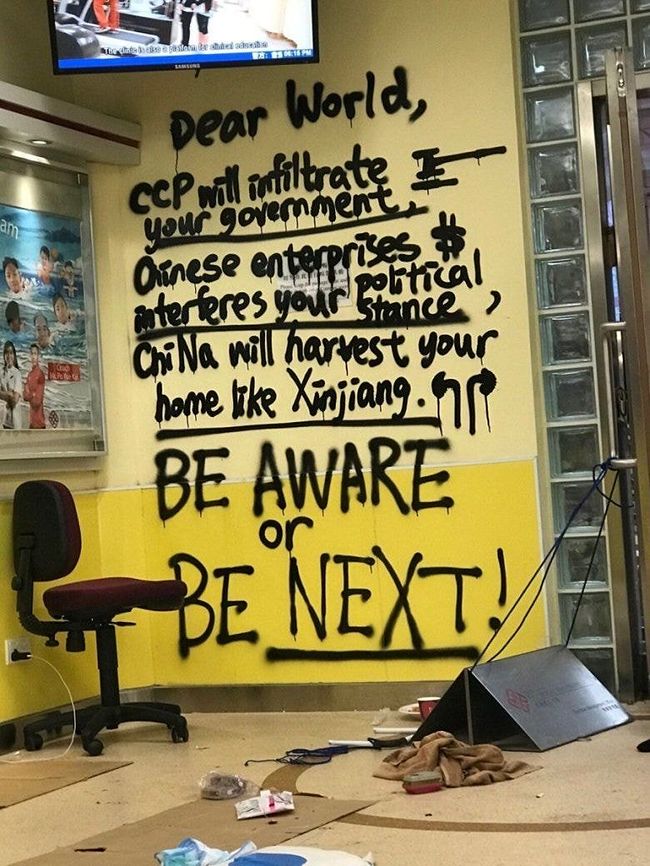
The current conflict between the United States and China is a confrontation between two powers shaped by fundamentally different strategic mindsets. But why wasn’t it easy for the United States to preemptively respond to China? Taoguang yanghui (韜光養晦), meaning “to hide your strength and bide your time,” is a classical Chinese idiom that became a key component of Deng Xiaoping’s foreign policy strategy, often referred to as the “28-character strategy.” 3 This policy emphasized keeping a low profile and building national strength quietly. According to some accounts, the idiom has been associated with an episode in Romance of the Three Kingdoms, where Liu Bei concealed his talents and feigned incompetence in front of Cao Cao as a survival strategy. Deng Xiaoping adopted the notion of taoguang yanghui in the late 20th century as China focused on economic development and strategic patience on the international stage. This approach was continued under Jiang Zemin and Hu Jintao, leading many Western analysts to believe that China would eventually liberalize and integrate into the U.S.-led global order.
In the chess-like strategic thinking of the United States, taking proactive measures was difficult before China showed its claws, as no clear front line had been established. Xi Jinping became the General Secretary of the Communist Party in November 2012, assuming the position of China’s top leader. Having witnessed the collapse of Lehman Brothers and the fragility of the Western financial system, he unveiled his vision under the worldview of “the East is rising and the West is declining” (东升西降). Under the banner of the “Chinese Dream,” he openly bared China’s claws, urging the nation not to forget the “century of humiliation” and to overcome the humiliations inflicted by Western imperial powers in order to achieve national rejuvenation. The following year, he became the President of China. This strategic shift was not a sudden maneuver but part of a long-term plan—one that had been prepared decades in advance.
In general, individuals at the micro level often make the mistake of applying personal, everyday moral frameworks to macro-level power struggles such as international politics and geopolitical conflicts. However, once a person reaches a position with actual authority—the power to legislate, amend laws, or deliver judgments—the once-clear ethical boundaries begin to blur, and real dilemmas emerge. In any decision, there are winners and losers. A choice made in the belief that it is to save lives may, in fact, determine who lives and who dies—often only to realize too late that you’ve already chosen a side. When the referee steps onto the field and starts playing the game, making the “right” decision becomes infinitely more difficult—and no one is perfect. So I ask the readers to approach it without a moralistic lens.
From China’s perspective, shaped by a Go-like strategic mindset, sacrificing a few stones to preserve the overall position and create a stronger “shi” can be seen as the most “ethical” choice—a way to save more lives in the long run and avoid total war. In contrast, from the American perspective, where liberal democratic values are deeply rooted, treating individual lives as something that can be weighed or bargained over is morally unacceptable. Yet, depending on political circumstances, the U.S. has at times chosen full-scale war or accepted casualties in the name of principle. To Beijing, this may appear hypocritical: in their eyes, Washington has simply chosen a different side, not a higher morality. This divergence is not merely about political strategy but about fundamentally different moral frameworks—ones that can be metaphorically mapped onto the contrasting logics of Go and chess.
In psychological terms, the difference in strategic thinking between the United States and China resembles overt aggression versus covert aggression. Overt aggression is more direct and physically oriented, evoking images of military power, financial sanctions, and actions aimed at winning battles. From the early years of its founding, the United States was strongly shaped by a frontier mentality and individualistic masculinity. Its strategic tradition of establishing clear front lines, applying pressure, and delivering shocks reflects a deeply ingrained, linear, and confrontational mindset—one that resembles overt aggression in psychological terms.
In contrast, China’s strategic behavior, as described above, is more indirect and long-term, resembling covert aggression. Covert aggression involves using social networks or indirect means to express hostility—not through overt physical confrontation, but through subtle manipulation, such as damaging reputations or exerting quiet control. In projecting power abroad, China often prioritizes taking control of police and security institutions before confronting military forces. By focusing on policing—a tool of social order and control—rather than conventional military force, Beijing reveals its strategic orientation. This long-game, indirect approach mirrors the psychological dynamics of covert aggression.
In modern society, people tend to react far more sensitively to overt aggression—to masculine, visible forms of hostility. Physical violence, the direct use of military force, economic sanctions, or tariff wars are visible acts of aggression that immediately draw condemnation and dominate media headlines. In contrast, China’s covert strategies often go unnoticed, quietly exerting influence across many areas over long periods of time.
President Trump deliberately employed the madman theory, and every word he uttered was met with criticism. Meanwhile, China caused far greater harm in ways that were harder to detect and confront—from trafficking drugs and operating organ trade networks to suppressing individual freedoms. These actions take much longer to recognize, and even longer to undo. China’s strategy bypasses people’s psychological threat-detection systems, silently tightening the board and leaving deeper structural damage—all while delaying public awareness and response.
People fear the loud pacifist more than the silent tyrant. This asymmetry of perception is one of the core battlegrounds in the U.S.–China strategic rivalry. Greater research and public awareness of covert aggression and the Go-like logic of “shi” are essential to make the invisible visible—and to ensure that silent threats are no longer ignored.
Footnotes
-
David Lai Dr., Learning from the Stones: A Go Approach to Mastering China’s Strategic Concept, Shi (Carlisle, PA: US Army War College Press, 2004), 6. ↩
-
Niall Ferguson, Doom: The Politics of Catastrophe (Penguin, 2021), 26. ↩
-
Vijay Shankar, “The Resurrection of Xi ‘Zedong‘”, Institute of Peace and Conflict Studies (IPCS), September 30, 2020, https://www.ipcs.org/comm_select.php?articleNo=5730. ↩